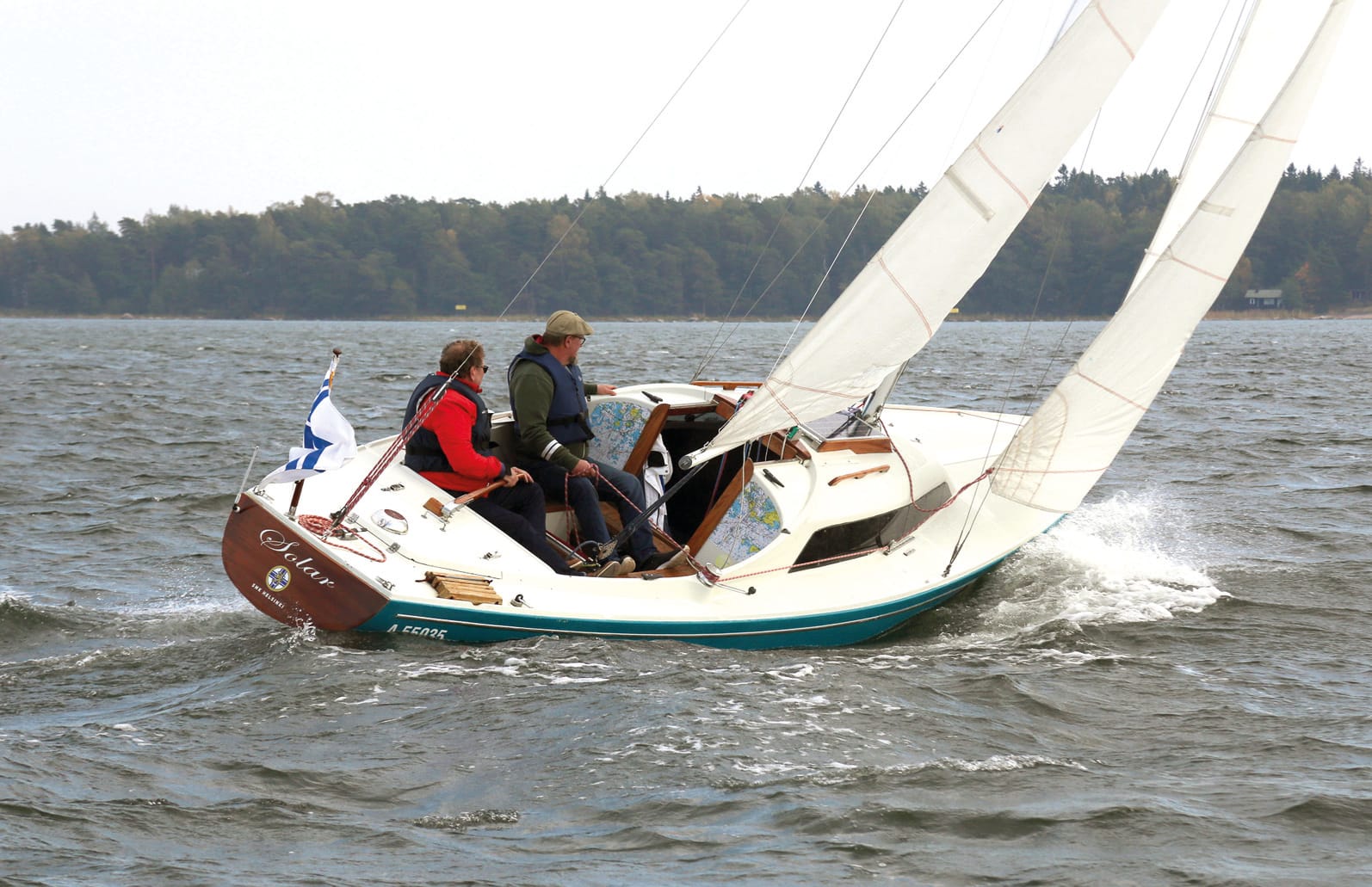
A new life for a beautiful sailboat
The Hybrid-H is easy to handle even in a tight harbor and can be sailed alone without leaving the cockpit, getting out on the water every day if you wish. Additionally, it is environmentally friendly with minimal operating and maintenance costs.
The project uses second-hand, affordable H-boats from the 70s and 80s (designed by Hans Groop) as base boats – recycling at its finest.
Hybrid-H is not a commercial project – it promotes responsible and environmentally friendly boating.
Article in a Finnish boat magazine: https://venemestari.fi/tuote/uudesti-syntynyt-hybrid-h-vene/
Most Visible Innovation
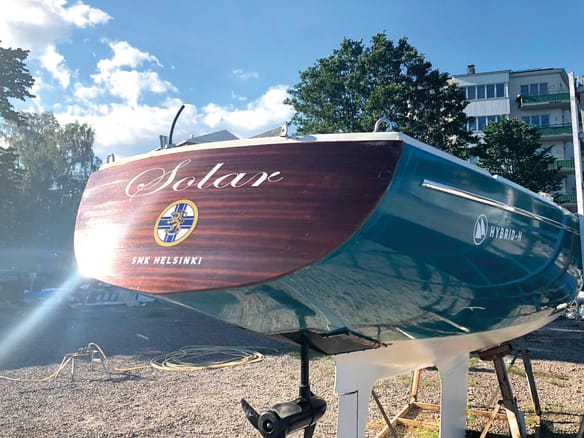
The disappearance of the outboard motor from the transom along with the cumbersome mount, gas tank with fumes, connecting hose, etc.
This boat is equipped with an approximately 5 hp electric outboard motor integrated into the hull, which is even more affordable than a traditional long-shaft outboard motor.
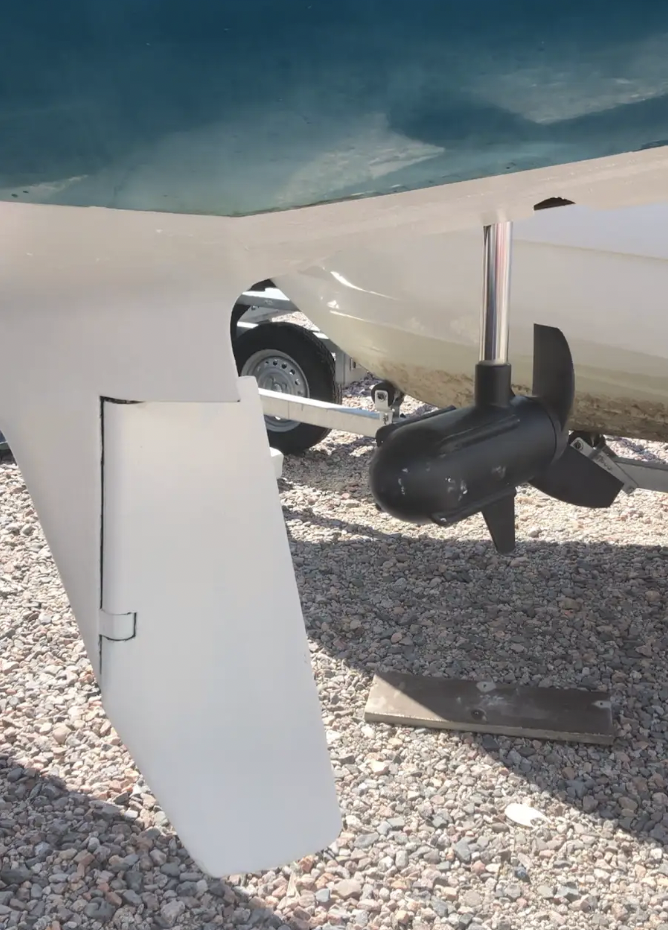
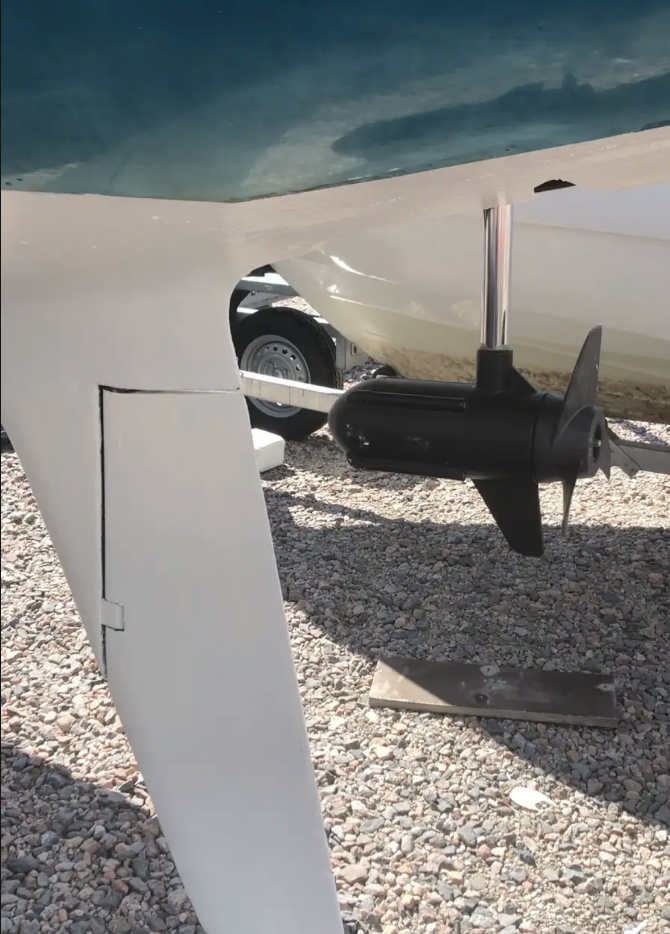
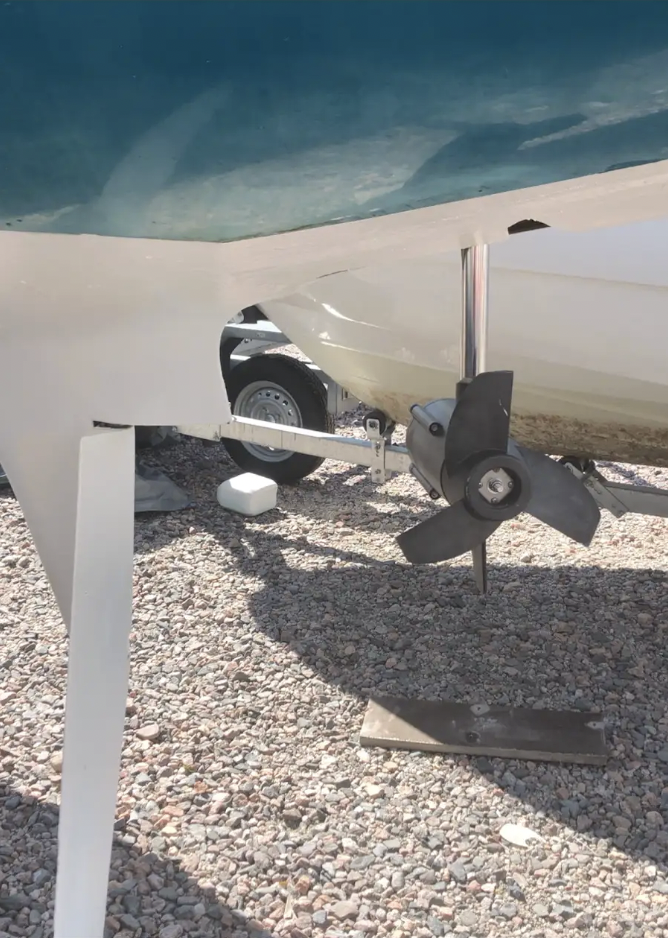
The motor can turn with the rudder
Enhanced Appearance
When the outboard motor and mount are removed, the boat's beautiful appearance can be further enhanced with, for example, a glossy varnished mahogany transom.
Practical Experience
The Artekno H-boat from 1974 acquired for the project in 2017 was originally in quite shabby condition. With one spring season and two people's help, it was renovated both inside and out.
The boat has been in use for about five years. All constructed innovations have functioned as expected.
The boat has been heavily used due to its easy handling, having been skippered by people aged 14-75 years without problems. Out of the harbor and motor up/down as if "at the push of a button" from the cockpit.
ECO BOAT! ZERO EMISSIONS
Runs clean on sun and wind
Even out to sea every evening: The Hybrid-H boat leaves the dock at the push of a button.
Battery System
The boat's 2x120 amp-hour batteries are positioned in the cabin, in hidden spaces under the galley and chart table. They add approximately 80 kg of additional weight to the low center of gravity on both sides of the keel, increasing stiffness and thus improving sailing characteristics, especially when sailing solo.
The hull-integrated electric outboard motor raises and lowers in seconds
Storage and Operation
The motor is stored in harbor and while sailing in a watertight and sturdy housing recess built into the hull.
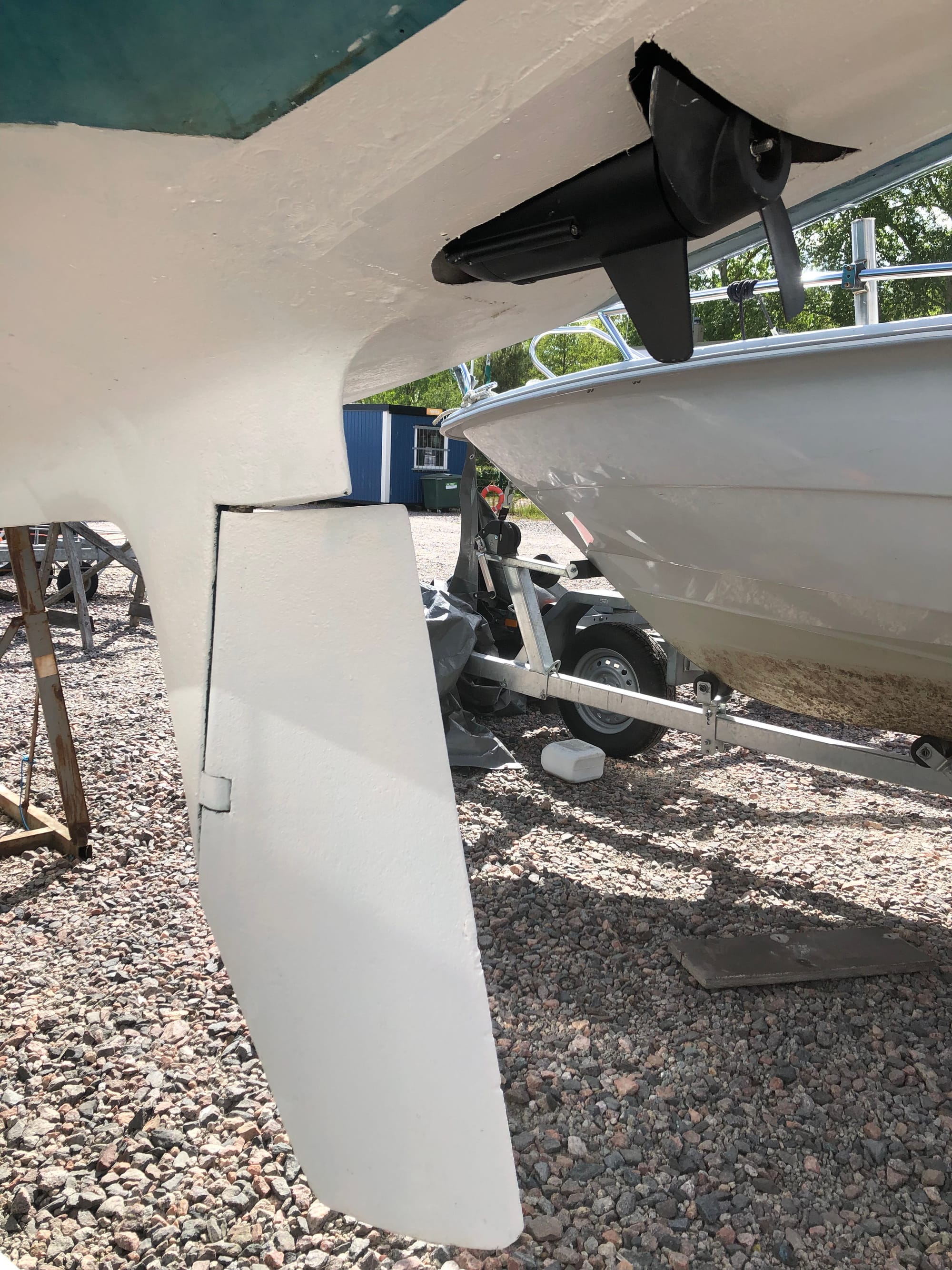
The motor raises and lowers into this space with a light hand movement in a couple of seconds. So there is no hole in the hull.
Steering System
The motor is connected to the rudder shaft with a quick-locking push rod, so it turns simultaneously with the rudder.
The boat is extremely easy to handle coming and going - turns like a car and rotates even in place in both directions like an azipod.
Technical Details
- Motor recess is above the waterline
- Motor lowers approximately 30 cm below the water surface, doesn't cavitate
- Rudder and motor turn 90 degrees in both directions
- System takes up space in the aft compartment equivalent to a small box
- Aft compartment laminated as separate and watertight section
Versatile Use
The push rod can also be attached to a fixed point. In this case, the motor locks into straight ahead travel disconnected from the rudder shaft, facilitating motor sailing in calm conditions etc. on longer trips.
The motor is installed on the boat in two parts. The motor in the hull housing and the cover on the cockpit rail console, so that the pull-out "throttle handle" remains visible for control.
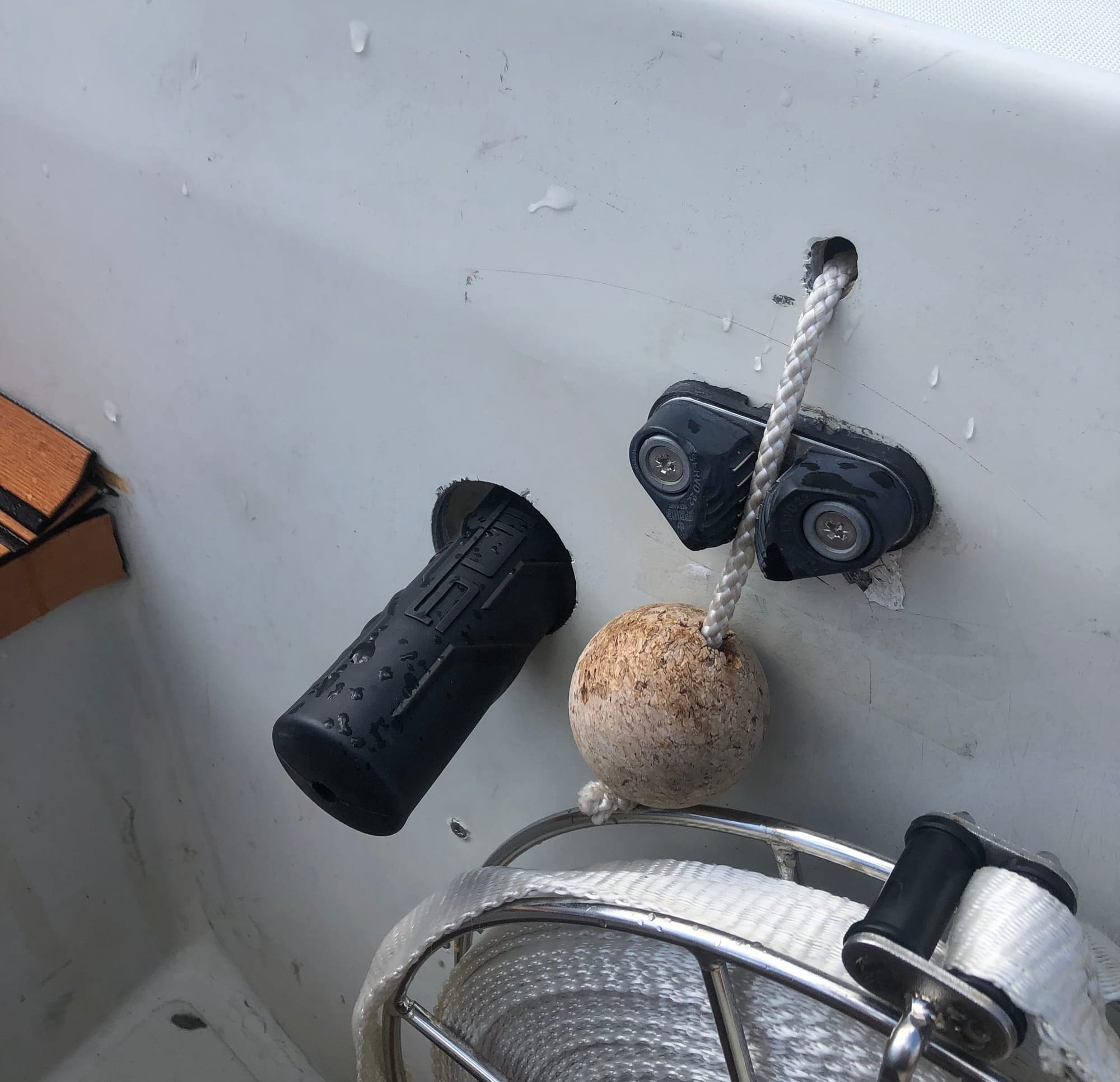
For easy sailing, the Hybrid-H is equipped with a tiller autopilot and extending jib pole. The motor is raised and lowered using a tackle rope in the lazarette.
The system has worked flawlessly for 4 years; in 2022 a more powerful 5 hp motor was installed.
And several other sailing-friendly innovations
Roller Furling Jib
The boat has a roller furling jib. It is structurally profile-less, so it doesn't impair windward performance.
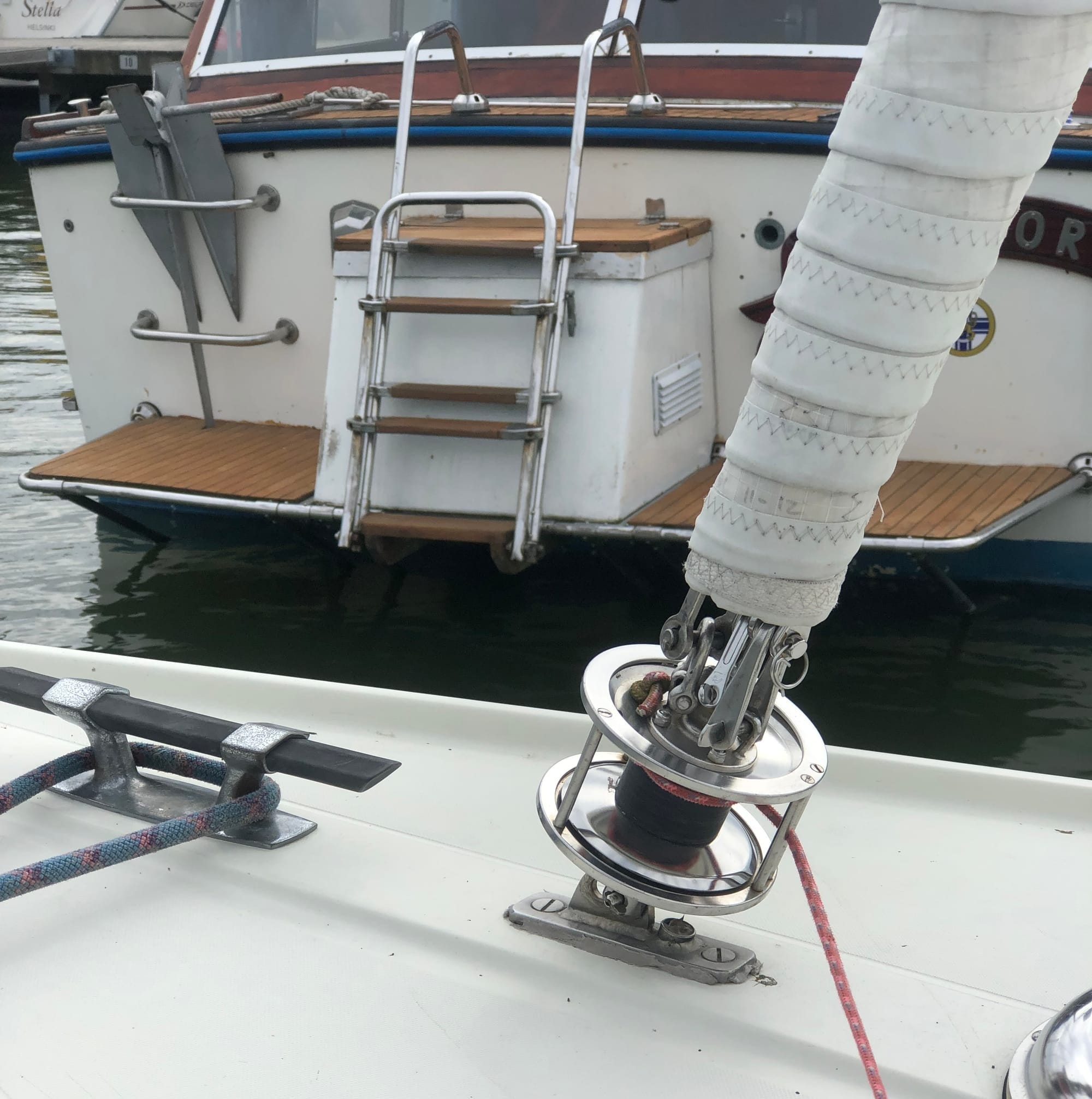
When sailing with basic sails, there's no need to leave the cockpit to go on deck. Roller furling is not prohibited by class rules, so the boat's racing capability is maintained.
For the mainsail, the boat has control lines between the boom and mast, plus a boom vang.
Halyard Winch
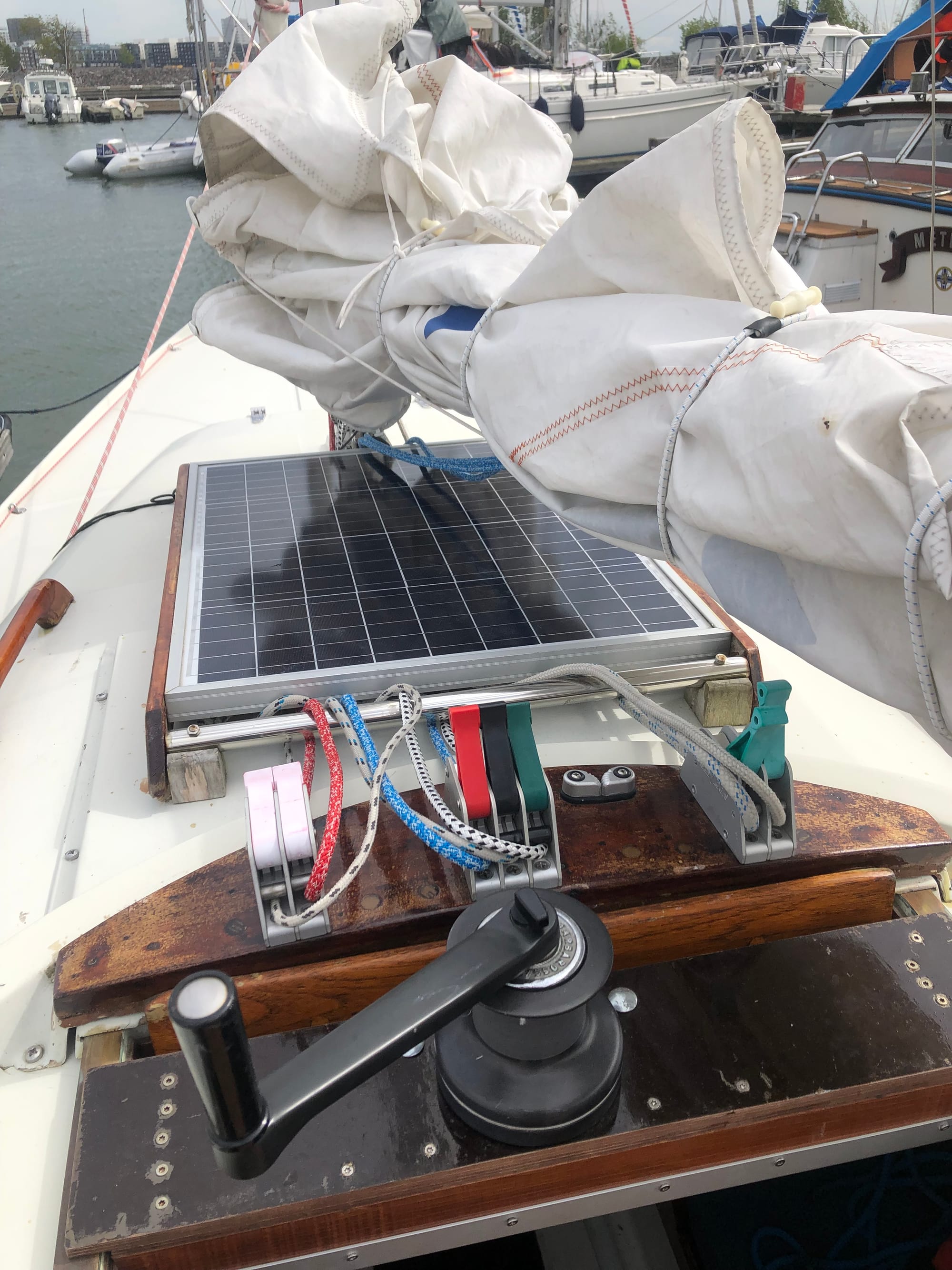
A removable two-speed halyard winch with mount installed at the cockpit opening helps with raising the mainsail and fits well at the rope clutch location.
The solar panel is hinged at the front edge and serves as a "rope storage" in harbor where ropes are protected from sunlight. The rigging runs under the panel.
Integrated Sea Charts
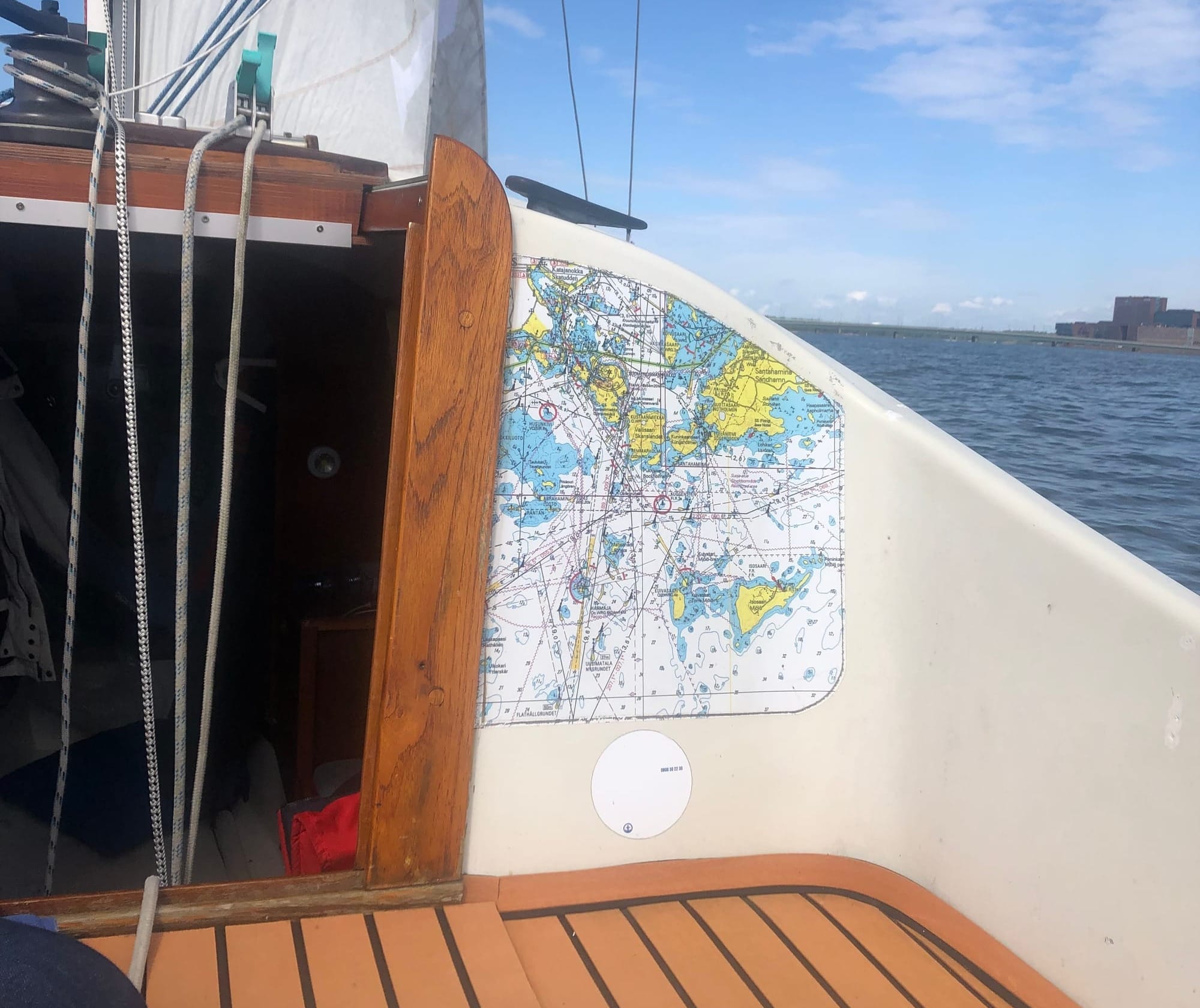
On both sides of the cabin hatch, laminated plastic sea charts are installed for day sailing.
- Starboard chart covers east to Villinki
- Port chart covers west to the Suvisaaristo archipelago
Charts are updatable and provide significant help when sailing in nearby waters. The boat's home port is Lauttasaari.
Cockpit Flooring
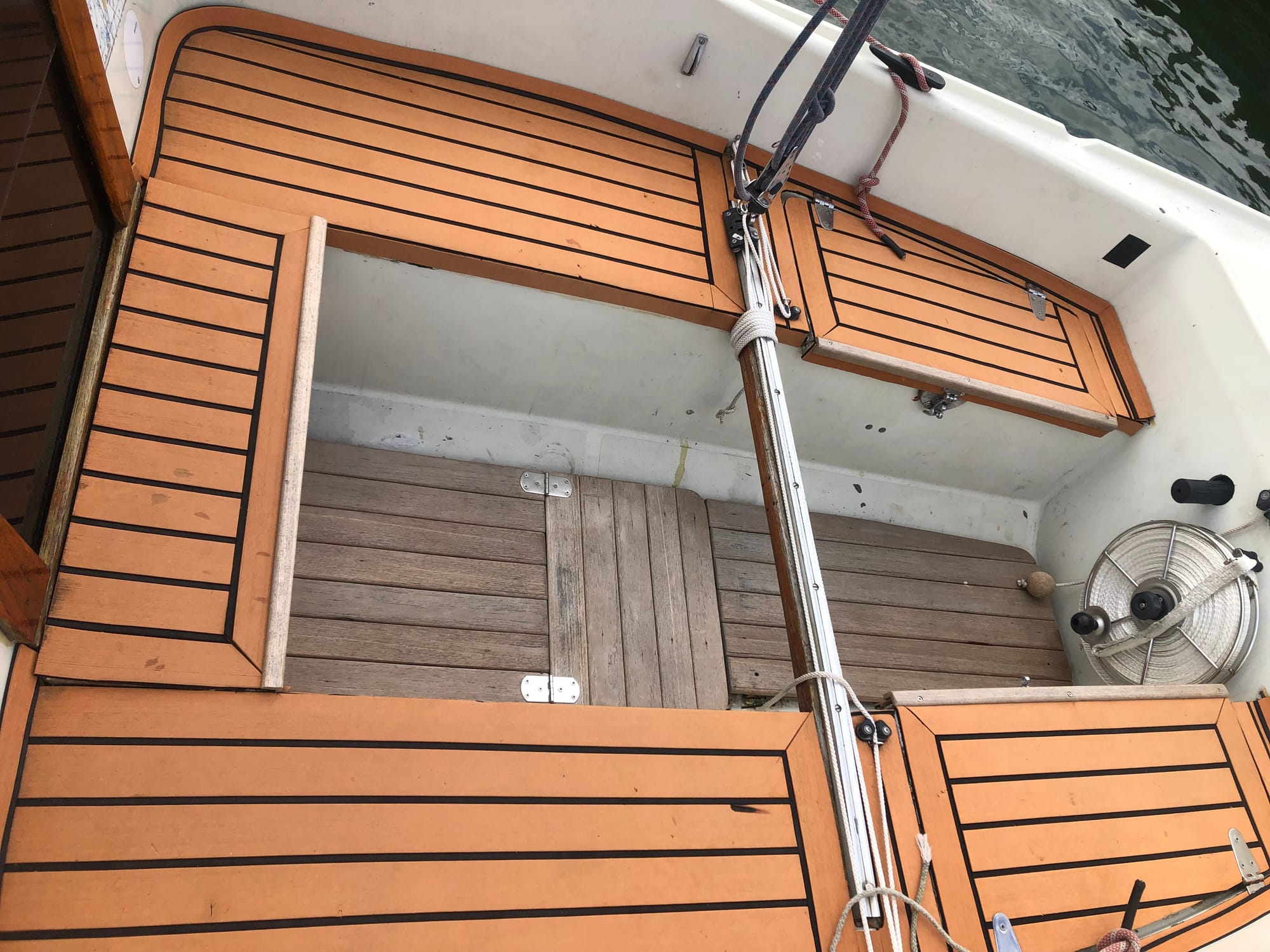
The cockpit is covered with synthetic teak, grating made in three sections. Under the hinged center hatch are the cockpit drain holes, so their operation is easy to monitor and clean.
Bar Counter
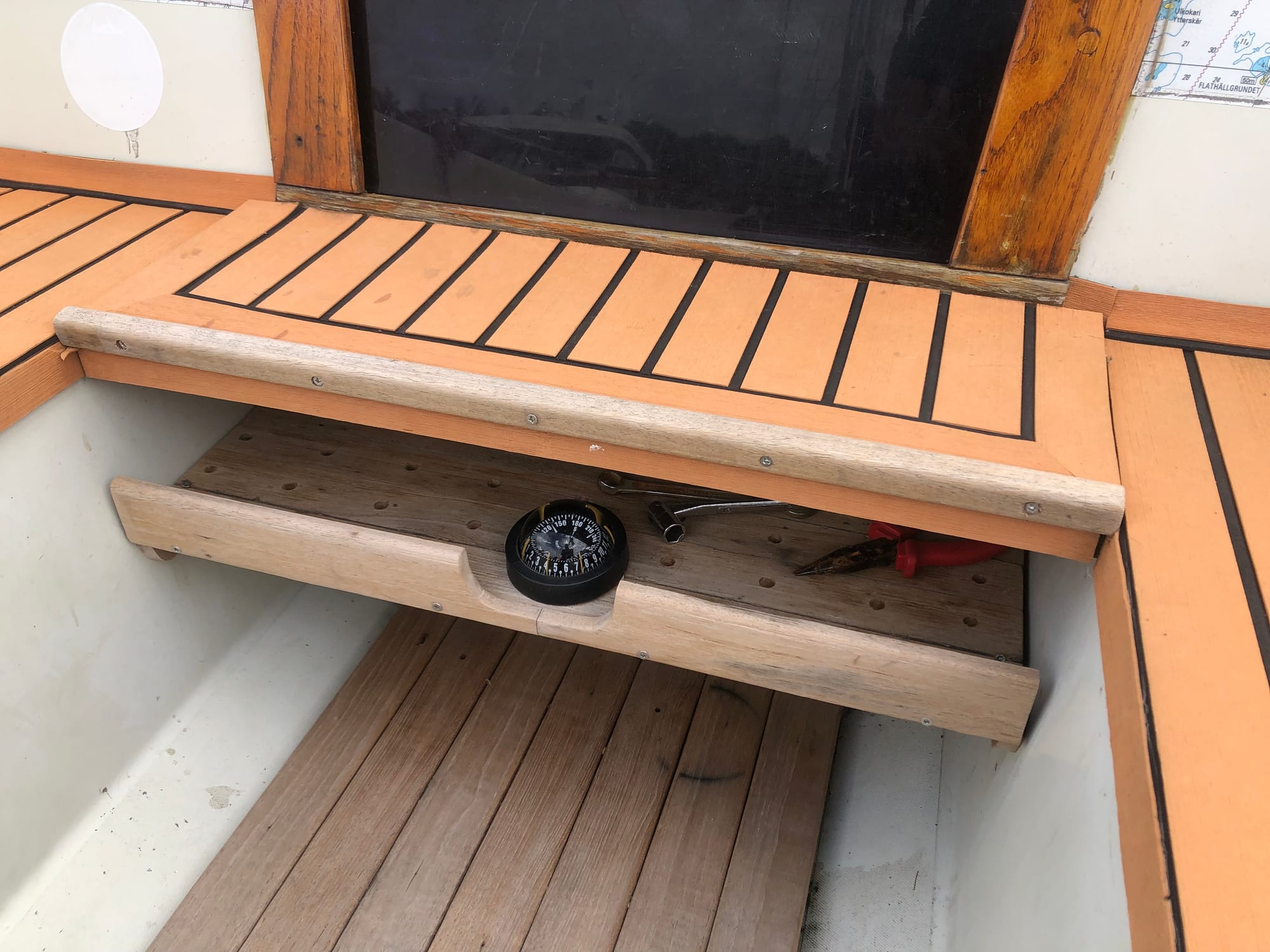
A "bar counter" has been built in front of the companionway, which helps with serving to the cockpit and works helpfully as a table.
It also protects the lower shelf which has a mount and power outlet for iPad and phones. The compass is a removable model, simultaneously a hand-bearing compass.
Solar Panel
The deck-mounted solar panel has 60 W capacity and is sufficient to maintain battery power if the motor is used two to three times per week for harbor entry/exit.
For longer trips, the boat has a fixed shore power charger.
Hybrid-H development plan for seasons 2025-2026: energy mast
The goal is to create a boat that runs entirely on wind and solar power. It's not quite there yet, as it's charged a few times per season with a fixed shore power charger.
Complete energy independence may be achieved when suitable solar panel sheets are found to coat the mast. Flexible panel strips totaling 300 watts can be attached to the mast by gluing.
The prerequisite is that they are reasonably priced, unobtrusive, suitable for the purpose, and don't affect the mast's properties. A vertically mounted panel may not be optimal, on the other hand, the low northern sun hits it better depending on the time of day.
Who is Hybrid-H for?
The boat's ease-of-use features may not be essential for experienced active sailors or racers. Perhaps some of them also appreciate easy transition to sailing waters.
Hyprid-H is designed as a boat for everyone. The H-boat is beautiful and, in addition to good sailing characteristics, moves reliably and easily under motor power.
Suitable for:
- Elderly sailors
- Beginners
- Cottage sailors
- As a second boat for powerboaters
- Families
- Club boat
- Junior sailors
Hyprid-H is a straightforward option. The H-Boat is also seaworthy, withstanding rough conditions even better than large cruising boats.
With its shallow draft, silent, sensitive electric motor, ability to turn in place, and precise tiller that responds even at very slow speeds, the boat is suitable for finding natural harbors.
Acquisition, Operation and Maintenance
Acquisition Costs
Boat acquisition, operation and maintenance are affordable. In addition to construction work, acquisition costs are €5,000-10,000 depending on the acquired base boat and motor prices.
Example boat costs:
- Base boat: €1,000
- Motors, panels, batteries, chargers, roller furling etc.: €3,500
- Total: €4,500
From the old outboard motor with tank and mount that comes with the boat, you can get €200-600 when selling it as unnecessary.
Availability
The H-Boat is virtually the only boat from which such a concept boat can be built. There are 6,000 of them in the world, of which approximately 1,000 in Finland, and there's sufficient supply of boats manufactured in the 70s and 80s.
Sails
Usually the acquired boat has reasonably good sails to get started. For sail replacement, used racing sails can be found - supply is good and a fairly decent set might be obtained for under €1,000.
Operating Costs
Of course the boat has normal haul-out and berth fees, but for example, the entire season's insurance costs are around €100.
Technical Information
Motor and Electrical System
- Motor: Haswing 5.0, approximately 5 hp
- System: 24-volt system
- Batteries: 2 x 120 amp-hour batteries
- Charging: Smart charger, 12-volt converter
- Solar panel: 60 W
Capacity
Performance
The motor is a so-called pontoon motor, meaning it moves the boat even in rough conditions against the wind. Average cruising speed is between 4-5 knots.
Range
Range was tested "on the bench" with the motor running at 80% power forward while the boat was tied to the dock.
- Motor ran at cruising speed RPM for 6 hours
- Estimated distance in calm conditions: 20-30 nautical miles
This is quite sufficient, as the H-boat sails well even in light winds and tacks excellently.
PROJECT HYBRID-H®
A new life for a beautiful sailboat